Indian Motorcycle: Choice is Coming Teaser Campaign


-
http://www.collemcvoy.com/wp-content/themes/images/ss_image/indian_ss_910_1.jpg
-
http://www.collemcvoy.com/wp-content/themes/images/ss_image/indian_ss_910_2.jpg
-
http://www.collemcvoy.com/wp-content/themes/images/ss_image/indian_ss_910_3.jpg
-
http://www.collemcvoy.com/wp-content/themes/images/ss_image/indian_ss_910_4.jpg
-
http://www.collemcvoy.com/wp-content/themes/images/ss_image/indian_ss_910_5.jpg
For the last half century, there has been only one option for bikers who want an American motorcycle with a rich, legendary history. As America's first motorcycle company, Indian Motorcycle is bringing choice back to the industry. This teaser campaign, created by Colle+McVoy, begins to set the stage for the worldwide reveal of the all-new Indian motorcycle later this year.
Caribou Coffee: Amy’s Blend
Caribou Coffee Amy's Blend


-
http://www.collemcvoy.com/wp-content/themes/images/ss_image/cbou_amysblend_910_1.jpg
-
http://www.collemcvoy.com/wp-content/themes/images/ss_image/cbou_amysblend_910_2.jpg
-
http://www.collemcvoy.com/wp-content/themes/images/ss_image/cbou_amysblend_910_3.jpg
-
http://www.collemcvoy.com/wp-content/themes/images/ss_image/cbou_amysblend_910_4.jpg
-
http://www.collemcvoy.com/wp-content/themes/images/ss_image/cbou_amysblend_910_5.jpg
-
http://www.collemcvoy.com/wp-content/themes/images/ss_image/cbou_amysblend_910_6.jpg
Amy Erickson was a roastmaster at Caribou Coffee who lost a valiant battle to breast cancer. A special blend is created each year in her honor and 10 percent of the sales are donated to Susan G. Komen for the Cure®. This year, in addition to coffee, merchandise and point-of-sale items, our client asked us to create packaging for a new Amy’s Blend Red Tea. We were honored to work on a project that recognizes such a brave and beloved person.
I Get Paid to Do This?
Chief creative officer Mike Caguin gave a longer version of this speech at the Student Advertising Summit in February. For recent, and not-so-recent, grads heading into an advertising career, it’s also a good reminder of why they found this path so alluring in the first place.
It’s 1962 in New York City. Don Draper is looking at a second round of creative concepts for Mohawk Airlines. He sent his creative teams back to the drawing board just 24 hours ago because the work wasn’t good enough. Peggy Olson, a young, talented copywriter, and her art director partner, Sal, lay their work on Don’s desk with conviction. They’re confident they’ve nailed the campaign. They show two ads. Each concept overtly depicts an attractive woman in a short skirt. Pop quiz: who’s the target audience? It’s an attempt to deliver upon one of the oldest clichés in advertising: sex sells.
Don hates it. He steers the conversation in search of a deeper meaning for the fledgling airline. When Peggy challenges him, he counters, “Just so you know, the people who talk that way think that monkeys can do this. They take all this monkey crap and just stick it in a briefcase, completely unaware that their success depends on something more than their shoeshine. You are the product. You—feeling something. That’s what sells. Not them. Not sex. They can’t do what we do, and they hate us for it.”
Like any good period fiction, “Mad Men” is an exaggeration of what was the truth. Many of its characters carry enough personal baggage to fill a Boeing 747—they chain smoke, drink heavily, use drugs, cheat on their spouses. They are almost all morally questionable. Sounds like the best job on the planet, doesn’t it?
Of course, all of that juicy stuff helps keep the storyline interesting, but when you strip away all of that, you’re left with an industry and career choice that are still unbelievably exciting. What Don Draper meant when he said, “You are the product. You—feeling something,” was that when advertising is at its best, it stirs your soul in a big way.
It’s the reason why every first Sunday in February we debate at great length and measure in infinitesimal detail the most memorable commercials of the Super Bowl.
It’s the reason why we all know someone who’s cried or gotten goose bumps because a commercial tugged on their heartstrings.
It’s the reason why some people proudly and permanently tattoo their bodies with company logos.
Or share something hilarious—it just happens to be an ad.
Or decide to train for that marathon after all.
Or feel compelled to help those in need.
And, whether we admit it or not—or consciously think about it or not—every person in this room owns the things they own, at least in part, because somewhere along the way those brands we wear, share and evangelize made us feel something.
It’s the same in 2013 as it was in 1962. When marketing is done well, it not only connects with people, it becomes a part of people. The only difference is that today, things are more exciting than they’ve ever been. Today, with technology changing every minute and the lines separating advertising, design, digital, media, product development and public relations blurring all the more, our creative sandbox is now infinite.
Here’s the best part of all this. You will find many moments throughout your career where you will say to yourself, “I get paid to do this?” Yes, yes you will. And it’s a beautiful thing.
Now Hiring: Account Supervisor
Position Summary
The responsibility of an Account Supervisor is to lead and motivate agency teams to help clients and their brands create a strong future. Specifically, he or she must be an active listener, a passionate partner and a brand steward, day in and day out. This role includes empowering involved teams, fostering collaboration and continually pushing for fresh, new ideas.
Click here for full description and application.
Colle+McVoy is an Equal Opportunity Employer.
Explore Minnesota Tourism: Minnesota in Six Words


-
http://www.collemcvoy.com/wp-content/themes/images/ss_image/emt_sixwords_ss_910_1.jpg
-
http://www.collemcvoy.com/wp-content/themes/images/ss_image/emt_sixwords_ss_910_2.jpg
-
http://www.collemcvoy.com/wp-content/themes/images/ss_image/emt_sixwords_ss_910_3.jpg
-
http://www.collemcvoy.com/wp-content/themes/images/ss_image/emt_sixwords_ss_910_4.jpg
-
http://www.collemcvoy.com/wp-content/themes/images/ss_image/emt_sixwords_ss_910_5.jpg
-
http://www.collemcvoy.com/wp-content/themes/images/ss_image/emt_sixwords_ss_910_6.jpg
-
http://www.collemcvoy.com/wp-content/themes/images/ss_image/emt_sixwords_ss_910_7.jpg

Just how far do you need to go to showcase how awesome the Land of Sky Blue Waters is? How about 1,500 miles, give or take a few.
Showing off the North Star State—the Gopher State, the Land of 10,000 Lakes, Minnesnowta, especially Minnesnowta, these days—was just what Explore Minnesota asked us to do.
But here’s the thing: We didn’t want to churn out a standard-issue tourism spot filled with a montage of prairie, lakes and more prairie and more lakes. That’s not how things are done here at C+M. Instead, we challenged ourselves to find six words that would seamlessly tie together compelling Minnesota-centric activities. The words that bubbled to the top were: spin, try, hold, rock, share and catch. Each word was the focus of its own 15-second spot.
Over the course of last summer (and deep into fall) we set out to bring this campaign to life. It was a fantastic experience. During 11 full days of shooting (not in a row), we covered more than 1,500 miles and captured exactly 52 different shot set-ups.
It was an amazing experience set against the backdrop of an amazing state.
Minnesota. Explore it.
Agency POV: Facebook Hashtags
So, the social world is all aflutter with news first reported by The Wall Street Journal that Facebook is working on incorporating the hashtag function into its platform.
As marketers we’re excited because hashtags on Facebook would provide a new search enhancement allowing users to group conversations and sort messages about one topic or news event. As social counsel, it gives us another tool to help brands find fans and get into conversations. It also could give us another tool on Facebook to promote conversations and much like Twitter, use hashtags to find fans, aggregate stories and react to trending conversations if relevant to the brand.
Not knowing what’s exactly coming though, our initial take is, “Why?”
The common language on Facebook is wordier and more conversational than on other social media platforms. It doesn't have the same post-length constraints as Twitter and Instagram. It’s even stranger when you think about Facebook's rollout of Graph Search, which is supposed to be so semantically smart in its parsing.
Why build a cornerstone feature that is so reliant on users to appropriately tag something with a hashtag? Why not build a search function that is actually smart enough to determine what’s relevant or recommend topic meta tags based on content without the distracting hashtag?
But rest assured, there’s a long-range plan behind it. Maybe it’s a positioning move to unseat Twitter as more people do all their socializing on their phone. Maybe it’s part of a grand plan for Facebook to bump Twitter from their hold on the instant feed.
Our faith is in your hands team Zuckerberg. We’re #waitingwithanxiousanticipationforyournewhashtagcoolness.
SXSW: It’s All About ME
Dear Marketer,
While everyone else in our industry attended SXSW as a developer, advertiser, designer, or what have you. I actually attended SXSW as your consumer. And what I learned is that your entire industry is slowly getting in on my little secret:
It’s all about ME.
Yup, you used to think that you could bucket me with a bunch of other people who have similar HHIs, genital parts and ages. You were essentially saying that Marilyn Manson, Bobby Brown and Tim McGraw were the same person and had the same values. Turns out that we all want to be spoken to individually and that technology and the digital space are enabling that. Not only do we want to be spoken to individually, we want it on our terms and on our own schedule. I don’t want to wait for episodes of my favorite show; I want the entire season and I want it now on any device (see: Netflix’s “House of Cards.”)
And I want to be the star of the show. At SXSW I got to sit on the throne from HBO’s hit series “Game of Thrones.” I got my picture taken and of course I put it on Facebook so all my friends could see ME. The New York Times made a profile of my face out of words, but then I learned that the words weren’t about ME—not cool. I visited the GE Brilliant Brew truck for a free latte and got my face drawn into the foam. I could have gotten a free latte with a GE light bulb drawn in the foam and only waited a few seconds, but instead I waited 45 minutes to get ME in the foam. It ended up looking like a mash-up of Abe Lincoln and Mr. Clean. But it was well worth the wait, Why? Because it was a picture of ME.
I was also shocked to see that brands were actually offering me things that I needed and wanted rather than yelling at me with a megaphone. Chevy offered me free rides around town through their “Grab a Chevy” program. AT&T let me power up my phone in a secure locker as I roamed the conference (while feeling naked without my phone). And countless brands gave me free stuff, like 3M post-its, battery packs and cell phone cases. The cell phone case came from a company that lets me customize and design my cover with—what else—pictures of ME.
The sessions were great, and, shockingly, they all revolved around ME. A few sessions touched on the power of humor, and I like to laugh—as long as you make it easy. And storytelling—I love a good story and you’re actually starting to learn that I would rather hear about the story behind your products than the features of your products. I attended Jonah Berger’s session (he’s the author of Contagious) and realized that you’ve started to figure out what makes things contagious. And as you suspected, it’s the content and type of content that makes things memes, not just calling them “viral” or making sure the right blogger or TV show mentions them. And, speaking of contagious, I waited in line one hour to get a picture of Grumpy Cat (and ME).
I even found it comforting to hear the stories of how Panera Bread and Whole foods are becoming more meaning-driven. It makes ME feel good when I eat there.
So keep it up marketers.
Best regards,
Your consumer (ME)
The "Dark Social" Meme
Senior editor at The Atlantic, Alexis Madrigal, last year published a blog post about social media and its impact in generating web traffic: “Dark Social: We Have the Whole History of the Web Wrong.”
With approximately 5,400 Tweets; 4,600 Facebook Likes; 1,200 shares on LinkedIn; and 1,100 +1s—to say nothing of the blog commentary and other related discourse in digital channels—it’s fair to say that “Dark Social” was a sticky idea that went viral.
To me, the main point of the post is that today's web analysts are decreasing the perceived value of social interactions in their reporting by relying on tools that track visits by referral sources—tools that invariably allocate otherwise socially driven traffic coming from, say, instant messenging and email to generic sources such as “direct” means.
Other, more general implications include:
- The notion that optimizing for social media means more than looking at Facebook and Twitter. The content itself has to be appraised.
- Formal social networks have brought a form of structure to social interactions that did not previously exist (in as simple a format).
- Along with the structure of formal social networks there is not only a loss in privacy, but a gain in social record keeping.
There have been plenty of counterpoints to the Alexis piece. For instance, the notion that the web has only been social since the rise of social networks (ca. 2005) ignores the fact that the Internet—of which the worldwide web is a part—has been social since its inception. Is anyone up for a dial-up chat on a local bulletin board service (aka BBS)?
Regardless of semantics about the Interwebs, I was intrigued by the notion that our analyses might be downplaying the true role of social interactions simply on account of our toolsets.
I therefore replicated the Chartbeat methodology Alexis outlined in “Dark Social” and ran a test of the site Colle+McVoy launched earlier this year for the Pedal Minnesota campaign (www.pedalmn.com).
Methodology
- Exclude Sources (relevant to the site I analyzed)
- Specific media vendors/partnerships (i.e., exploreminnesota, bringmethenews, tuneupstation)
- Exclude Media (relevant to the site I analyzed)
- CPC, organic, email
- Exclude Landing Pages (clearly not “Dark” in their nature)
- Home page (i.e., /)
- Main section header pages (i.e., /map/|/events/|/resources/|/pedal central/|/contact/|/partners/
Results

My results reflected the general patterns Chartbeat isolated with traffic data to The Atlantic. At first glance, this might suggest we need to be more thorough with any site reporting that requires us to be 100 percent certain about all socially derived visits. However, owing to other truths about site analytics and methodologies (deactivated cookies, for instance, decreasing what we can actually report as full and complete records), we will never be 100 percent certain about all such visits.
Analysts working in agencies should keep this in mind. As much as we'd like to report firm campaign results to our teammates and, ultimately, our clients, courtesy of web analytics tools that purportedly count unique visitors to your properties and tally the sources of their arrival to those properties, we need to be transparent about the fact that—unless we're pulling server logs—our data is always going to be directional.
What Is Your Super Bowl?
The Super Bowl is the most anticipated and talked about event in the advertising industry. It’s our Oscars, Grammys and Fashion Week wrapped into one. We expect to see some of the best creative, soundest strategy and most effective marketing of the year. But with all the flash and hoopla, how does it affect the average marketer? What can the millions of marketers, business leaders and entrepreneurs take away on Feb 3rd?
First, they should ask, “What is my Super Bowl?” Instead of looking at the event as the advertising star-studded night it is, consider it just a platform, a launching pad that top tier advertisers decide (or can afford) to leverage. Every marketer has a “Super Bowl” or big stage and you don't need $4 million plus (average cost of the Super Bowl media buy) to own it. While helping Caribou Coffee with a major rebranding effort, we approached the design of their coffee cups as their Super Bowl. After all, to the nation's second largest premium coffee shop, their cups actually garner the sort of impressions a commercial during the Super Bowl does. All of a sudden, the cup designs became a lead element in the campaign and everything followed.
And with Land O'Lakes, we treated their new mobile site as their Super Bowl. Today's busy Moms (and Dads) are turning more and more to mobile devices to plan and prepare meals, so we placed great emphasis on creating a user experience that was intuitive, simple and inspiring. After all, it will be used by millions of people.
Once you identify your Super Bowl, it might not reach hundreds of millions of viewers in one fell swoop—or feature the mishaps of Janet Jackson— but there are some things we can all learn from the big game that can be applied.
It's not just about showing up, it's about standing out.
Whether it's at a trade show such as CES, packaging on a store shelf, or something as simple as a sweepstakes—just think, what would happen if you treated it as if everyone was watching? Pretend for a second that USA Today is going to gauge your efforts with a meter the next day. That your family and friends are going to point out "I know the person who did that…" The reason so many Super Bowl spots are memorable isn't just because they cost a lot of money. It's because a lot of thought went into them. No one wants to disappoint.
Make sure it’s the right kind of memorable.
Too often, in their efforts to stand out, advertisers make the mistake of not linking their creative idea to the uniqueness of the product. They do a great job making people laugh, or maybe even coaxing a tear or goosebumps with a heartfelt message, but the viewer is unable to remember what brand moved them in the first place. Will your audience walk away your Super Bowl message the way you'd like?
Get the most out of your investment.
Two trends have emerged from advertising during the big game. First, creating buzz for your ad prior to game day is a great way to make your marketing dollars work harder. Can you tease your Super Bowl effort before it launches?
Second, advertisers are doing an increasingly good job of tying a social component to their spot, whether it’s an online game or asking viewers to vote for the ending of the spot on Twitter. By doing this they engage consumers, increase conversations and build buzz. Be sure you’ve employed all the tools in your marketing toolbox to promote your Super Bowl.
Social Sharing Buttons Are Overrated
Seeing social media sharing buttons across the top of a site has become the norm. Facebook, Twitter, Pinterest and even Google+ have buttons on almost every page we see. Some tools, like addthis.com, even let you add over 300 social network buttons to your site. With all these choices, how do you determine which networks are the best for your site?
Through testing, we set out to identify just that, the best set of social sharing buttons to include on one of our client sites. What we found was surprising: Pinterest is both the hero and the villain of social sharing buttons.
What We Did
We tested two different combinations of sharing buttons. The Original Set included buttons for Facebook and Twitter. The Test Set added Pinterest and Google+ buttons, along with a “more” dropdown that included tumblr and StumbleUpon. Each set was presented about 50% of the time on a highly trafficked site. We tracked shares using both Google Analytics and network specific insights platforms, such as Facebook Insights.
What We Learned
The Pinterest button has volume, Facebook is close
In the Test Set, Pinterest and Facebook accounted for 63 times more button shares than all four of the other networks combined. In the Original Set, Facebook outperformed Twitter by a factor of 93. So, for this audience Google+, Twitter, StumbleUpon and tumblr sharing buttons are all non-factors. We can’t make blanket statements about the success of those network buttons, as this behavior is audience driven, but those networks regularly have a lower volume. Visitors are still sharing content on lesser networks, but it appears that they prefer other methods of sharing than buttons.
The Pinterest button bullies Facebook
The addition of the Pinterest button increased the total number of button shares almost 500%, but came at the cost of a 33% reduction in Facebook Likes and shares. In fact, adding the Pinterest button led to a 31% loss of shares on all other networks. It would seem that visitors are only willing to share using one button, and that Pinterest takes precedence. Is Pinterest worth the reduction of Facebook shares?
The Pinterest button also bullies Pinterest
When given the option to use a sharing button instead of an organic method, such as the Pin It! bookmarklet, visitors will use the button. This seems obvious, but there are some implications. There was a 30% reduction in organic Pins once the Pinterest button was added. So, total button shares went up with the addition of a Pinterest button, but a majority of the increase was from people using the button instead of sharing organically; ultimately at the cost of Facebook interactions.
What’s the value of a Pin?
The value of a social share is as contested as the measurement as value of a social follower. Pinterest, being new and unique, is even harder to define. There’s a few subtle ways Pinterest and its users behave that provide some insight into the benefit of a Pin.
Pins quickly lose branding. While looking at your feed, no source is displayed for Pins or Repins. In fact, to see the source while shifting through a person’s pins you need to navigate to the particular user’s individual boards. Repins account for 80% of all Pins, one of our client’s popular photos last month was pinned 13 times from the site and repined over 11,000 times. The mobile experience behaves similarly.
So, without a user taking extra steps to find the source of a Pin, it remains fairly anonymous. If your photo content is not easily recognizable, Pinterest users will likely not know it’s related your brand. If your brand has easily recognizable content, such as cars or mascots, branding will remain. Except for a few iconic pieces, food, clothing and furniture are all products examples that often are Pinned without brand recognition.
If you run a photo-centric site, you’ve undoubtedly noticed spikes in Pinterest referrals. For sites we track, usually one or two Pins are responsible for the majority of the increase. On average, we’ve seen visitors from Pinterest spend 70% less time on site, have a bounce rate increase of 30%, and mostly view only the page they landed on from the Pin. In the data we analyzed, site visitors from Pinterest provide little value to high-level objectives.
Takeaways
Unless you’re targeting an audience that matches a lesser-used network’s demographics, leave the buttons off the site and let people share organically.
While some brands have used Pinterest accounts correctly, value for most brands lies in the organic pinning already happening without a Pinterest button.
We’re big believers in never-ending testing, so this is just the beginning. As we roll out other styles and combinations, we’ll let you know how these initial findings change.
Land O’Lakes: Mobile Relaunch
Land O' Lakes Mobile


-
51787368
-
http://www.collemcvoy.com/wp-content/themes/images/ss_image/lol_mobile_02.jpg
-
http://www.collemcvoy.com/wp-content/themes/images/ss_image/lol_mobile_03.jpg
-
http://www.collemcvoy.com/wp-content/themes/images/ss_image/lol_mobile_04.jpg
-
http://www.collemcvoy.com/wp-content/themes/images/ss_image/lol_mobile_05.jpg
Visit the site: http://m.landolakes.com/ »
Solution
We worked closely with the team at Land O' Lakes to design & develop a mobile experience custom-crafted for the mom on the run.
Awards
Objective
Since the early 1920s Land O’Lakes has strived to bring good food to busy families. Today that means providing a resource for moms constantly on the go. The new Land O’Lakes mobile site contains a practical navigation that can quickly serve up products, recipes, and inspiration whenever and wherever moms need it.
Medtronic Foundation: Save-A-Life Simulator
Medtronic Save-A-Life Simulator


-
http://www.collemcvoy.com/wp-content/themes/images/ss_image/med_sals_910_3.jpg
-
47248653
-
48309501
-
http://www.collemcvoy.com/wp-content/themes/images/ss_image/med_sals_910_9.jpg
-
http://www.collemcvoy.com/wp-content/themes/images/ss_image/med_sals_910_10.jpg
-
http://www.collemcvoy.com/wp-content/themes/images/ss_image/med_sals_910_11.jpg
-
http://www.collemcvoy.com/wp-content/themes/images/ss_image/med_sals_910_12.jpg
-
http://www.collemcvoy.com/wp-content/themes/images/ss_image/med_sals_910_13.jpg
-
http://www.collemcvoy.com/wp-content/themes/images/ss_image/med_sals_910_14.jpg
Sudden cardiac arrest has become the leading cause of death in the United States. To educate people on how to respond if they witness someone collapse, we created the Save-a-Life Simulator, an online experience that lets users make virtual life-or-death choices and teaches the proper steps to follow. In just a few short months, the Save-a-Life Simulator has received 2.5 million unique visits, educating people all over the world so real lives will be saved.
Five Ways To Be Remarkable
At a time when many bright-eyed college graduates are embarking on their first internships or “real” jobs, it seems appropriate to offer some advice on how to be successful. First, you must understand that you cannot fail. Every new endeavor is an opportunity to learn and to grow. Sounds cliché, but it’s true.
You know you’re smart. Now you have to prove it. Based on my experiences, you can do this by being an incessant learner, thinking critically, building strong relationships, understanding expectations and showing passion along the way.
Keep learning
Learning doesn’t end after college. In a very real way, it’s the start of you creating your own curriculum. Look for inspiration everywhere. Read articles and books, study people and places, attend events, talk to smart people – just get out there and soak it up.
Think differently
If you’re asked to do something, don’t just do it. Recognize the end goal and over-deliver. Find a different, better solution. Combat ambiguity by asking good questions. Asking questions demonstrates curiosity and the desire to better understand what’s trying to be accomplished. You’re not expected to have all the answers. No one does.
Build good relationships
Whether you’re extroverted or prefer to keep to yourself, you must create connections with people inside and outside of where you work. Cultivating strong relationships will help you navigate through your career – and your life. The easiest way to do this is to just be you. People will recognize when you’re being genuine and get to know you for who you really are – professionally and personally.
Understand expectations
One of the biggest barriers to surpassing expectations is not knowing what they are in the first place. Ask! On your first day, ask how your success will be measured. Then follow up after about a month by requesting a review to understand what you’re doing well and what you can work on.
Wear your passion
Finally, show that you’re passionate about what you’re doing. People don’t want just anybody representing their brand. They want a team of passionate, ambitious leaders who will advocate for the organization. Enthusiasm should shine in everything you do.
In short, be so remarkable that you make everyone else aspire to your awesomeness. Work every day to make yourself, and everyone around you, better. You’ll know when you’ve found what you’re meant to do because you’ll feel like a better you with every bit of effort you contribute to it. You’ll also know if you haven’t found it. You must continuously expose yourself to new information and experiences to find what makes you happiest. Remember, you cannot fail – so long as you try.
“Don’t ask what the world needs. Ask what makes you come alive and go do it. Because what the world needs is people who have come alive.” – H. Thurman
Open Advertising: Inspiring Intellectual Diversity In Agencies
As advertisers, we have incredible influence to move things forward and take on challenging issues of culture, society, technology and economics. We can spur honest conversations (even if they’re difficult), and create work that broadens discourse instead of reducing it.
In order to accomplish this, our industry needs diverse intellectual talent — people who see and experience the world in many different ways. But a disturbing trend is emerging: women and men who would have once pursued a career in advertising are being lured away with tempting offers from startups and tech companies (see 8 Reasons To Choose A Startup Over A Corporate Job). Attractive new job offers, coupled with a less-than-favorable reputation as an industry (advertising is the 10th most hated profession in the U.S. according to Gallup), means that advertising could be facing a very real shortage of diverse intellectual talent in just a few years’ time. A lack of talent means our industry’s point of view will become staid and our ability to create change will quickly fade.
The issue of talent is precisely what we set out to address in our recent collaboration with the 4A’s, a leading ad association looking to jump-start a dialogue with the next generation. The project was designed to share untold stories of real people who work in agencies. But before we could tell their stories, we needed to know what we were up against.
We began by talking with college students and young advertising professionals in order to understand the gaps that exist between students’ perceptions and employees’ reality. We asked similar questions of both groups and then compared their responses. The results were staggering: the things that students are most wary of are the same things young working professionals enjoy most.
In general, students believe that 1) You have to be a brilliant creative genius to make it in our field, 2) There aren’t enough ad jobs to go around for those who are interested, 3) Digital agencies are the only ones that work with new technology, and 4) Agencies are cutthroat, backstabbing places that eat their young.
Most of these perceptions are unfounded. First, young professionals told us that they thrive on the creativity in agencies, whether they’re an account executive or a copywriter. Second, they found jobs by landing internships, meeting the right people and having the right attitude, even when the job search sucks. Third, they work with emerging technology every day — it’s actually an area where they feel the most empowered. Finally, those just starting out in advertising told us story after story about how much they enjoy collaborating with coworkers, how welcoming agencies are, and how most of the folks they work with are driven to create great work rather than clutter the world with more garbage.
The disparity between perceptions and reality means that it's up to us to redefine creativity and show that there are many seats at the table, help students understand that finding the right internship is the first step toward finding the right job, communicate that technology is the lifeblood of every agency and an area where young talent rules the roost, and last but not least, show that advertising is the new team sport.
On the heels of our research came a new website, openadvertising.aaaa.org, designed to open up the walls of our agencies and welcome those who are skeptical, excited or curious about our field. The site features short videos from art directors, writers, strategists, analysts and account executives that show what a day in the life is really like, which we hope will dispel misperceptions along the way.
Colle+McVoy had the pleasure of creating four videos for the site that feature our employees. Take a peek at our stories (and the new OpenAdvertising site). We’d love to hear what you think about where our industry is headed and what we could do to make it better than it’s ever been before.
Melissa
Micah
Bethany
Nat
An Analysis of Social Media Engagement Tools
Maintaining a social media presence has become an essential part of the marketing mix for just about any consumer-facing brand. In fact, enterprise class corporations now have 26 employees on average creating social content on their behalf (Owyang, Jeremiah. Social Media Management: An Industry Perspective).
Although marketers realize that a social media presence is crucial, social media (or community) management is still a young discipline. Over 80% of enterprise-class corporations’ social media programs are less than three years old (Owyang, Jeremiah. Social Media Management: An Industry Perspective). The exciting part is best practices are still being forged all the time. This includes the emergence of a handful of social media engagement tools that aim to help social media teams listen to and interact with their communities.
It’s important for marketers to stay abreast of the tools that can make us more effective while engaging in the social space. That’s why we’re constantly evaluating social media engagement tools. Most of these tools include features like:
- Conversation streams from various social networks to keep an eye on what’s being said about your brand
- The ability to flag or assign posts for follow-up and facilitate collaboration between team members
- Publishing capabilities for multiple social networks to broadcast content to your community
- Post-level analytics to gauge the effectiveness of your content
Of course, you should always keep your specific social media objectives in mind when evaluating these tools. But, to help narrow the list, a recent evaluation from Colle+McVoy identified three frontrunners: Hootsuite, Buddy Media and SocialVolt.
In our particular case, we were looking for a tool with a good balance of collaboration features, real-time listening, post-level analytics and publishing capabilities across multiple networks.
HootSuite provides the most bang for your buck. It offers solid analytics, a decent user experience, and standard collaboration features like assigning community posts to team members for follow-up, for $5.99/month, plus $15 per additional user per month.
Buddy Media is a true enterprise solution, with a scalable offering that spans just about every social network. It is one of the few tools that provided options for publishing to a YouTube channel.
SocialVolt is solid across the board. Although more expensive at $1,800 per month for the professional edition and a website that leaves you needing a live demo for the full picture, we were still very intrigued.
The most important thing we learned through our evaluation is that there is no one-size-fits-all solution. No silver bullet. It’s extremely important to articulate your goals for the social space and tailor your team and tools to them. We did arrive at a clear decision for the tool that best fits our particular needs: HootSuite.
HootSuite provides all the necessities a social media team needs in a clean and intuitive interface. Collaboration is streamlined. Publishing capabilities include almost all social networks and post types. Analytics are integrated across the board. Customizable conversation streams on the home screen allow you to keep an eye on the conversation. And, perhaps an often-overlooked benefit, the training necessary for a team to use the tool would be minimal.
If you’re part of a social media team that could use some streamlining, there’s a good chance one of these tools could make your life easier. Just don’t forget to consider the whole picture before jumping on the bandwagon of any single one. It’s a long list.
Now Hiring: Assistant Account Executive
Position Summary
The role of the Assistant Account Executive is to support agency team members. He or she must coordinate and manage the activities on assigned accounts in such a manner that work is done to high standards, maximum efficiency and accuracy, on time, and within the specified budget parameters.
Click here for full description and application.
Colle+McVoy is an Equal Opportunity Employer.
We Eat, Sleep and Silkscreen Cycling
Art Crank Posters


It’s no surprise we’re a culture of cyclists at Colle+McVoy. Our latest output comes from Aaron Purmort, Lindsey Aho and yours truly. We’re three of the 40 local artists in the sixth annual ArtCrank - a poster art show that celebrates cycling. I asked Aaron, a returning artist, and Lindsey, a first-timer, about their experiences going from idea to execution.
Mike: Lindsey, this is your first time participating in ArtCrank. What made you decide to throw your hat in the ring?
Lindsey: I've always wanted to participate, but somehow have managed to miss the entry date. Not this year.
Mike: How about you, Aaron? You’re a veteran. How are you feeling about this year?
Aaron: I think it's very exciting every year. It's by far the biggest showing of screen-printed posters under one roof in our city annually, and I love screen printing. Seeing what other people come up with is always the best part for me.
Mike: How did your arrive at your idea? What was the inspiration behind it?
L: I didn't want the focus to be on just one type of bike. I wanted everyone to be able to relate to my poster.
A: I did a lot of drawing by hand while I was on medical leave from work, and I think that has influenced my designs since coming back to work. I do a lot more sketching now, and I've always loved drawing type by hand, I just do it more now. When I visited my parents in Scottsdale, Arizona this winter, I went on a bike ride to see my grandparents, who live on the other side of the city. The paths and roads down there are amazing for biking, and it got me thinking a lot about how cities other than Minneapolis have really started encouraging and putting money toward biking for commuting and recreation. Also, I had been doodling the American flag a lot lately, so I knew I wanted to incorporate that into my poster design somehow.
Mike: Did your idea come to you right away or did you labor over it? What was your creation process?
L: It was actually the first visual I saw in my head. Making it, though, was laborious. I always start out in pencil. Draw, redraw, trace, erase and draw some more. Then I ink. And finally, I take it into the computer and work on it some more.
A: I labored over how to fit the flag into a poster about biking, and after a ton of pretty horrible ideas, I started seeing the stripes in the flag as something that could be bent and warped instead of just straight lines. That led to my final illustration. I then worked with a friend who runs Big Table Studio (a fantastic place for printing!) in St. Paul on the printing.
Mike: Are you an avid cyclist?
L: Like most, I have enjoyed riding a bike since I was little. It's something that will always be a part of my life.
A: I'm not hard-core enough to bike in wintertime, but I try getting out as much as I can. It's been a little hard getting going this spring on bike commuting to work, because I've been more tired than usual due to medications. I wish I biked more, and will start to soon. I just sold my car, so I hope that will force my hand more this year.
Mike: Knowing that nearly 3,000 people attended ArtCrank last year, were you nervous during the process?
L: Yes. I'm fairly decent at procrastinating. But I didn't this time, because I didn’t want to screw anything up. It's always nerve-racking to show your work, and I don't think I'll ever stop caring whether people like it or not.
A: I'm always a little nervous showing work, but it's not really a forum where you're judged on the finished piece. It's definitely more of a celebration and a party. Thinking about the show that way helped.
Mike: What's your twitter handle so people can absorb your infinite wisdom?
L: @lindseyaho
A: @purmort
Mike: Are you going to the opening?
L: Heck yes.
A: Hell yes.
Mike: Me too. Can’t wait.
Now Hiring: Senior Digital Strategist
Position Summary
Working alongside brand planners and analysts, the Senior Digital Strategist translates brand strategy and data analysis into a clear point of view that outlines how our clients can best leverage interactive marketing. This person must be a pattern seeker as well as a dot connector. He or she will look for patterns through analytics, technology trends, audience insights and brand strategies. And she or he will connect the dots by architecting digital strategies influenced by our client’s business and marketing objectives. Once a strategy has been determined, the role of the Senior Digital Strategist becomes one of helping it translate into idea generation. All while partnering with the account, creative and technology teams to ensure the strategy is effectively implemented. This position reports directly to the Director of Interactive Innovation.
Colle+McVoy is an Equal Opportunity Employer.
People Google It...
...Even When They Know Your Website Address
According to a recent comScore ranking of search engine activity in the U.S., more than 20 billion total searches were conducted across major search engines in December 2011. That’s a lot. 3% more than were conducted the previous month.
But the figure shouldn’t be too surprising given the role search plays in our lives. Another recent set of data from comScore, shared in its annual U.S. Digital Future in Focus report, found that the U.S. market for search grew at an 11% clip last year. Not only did 2011 see a slight 3% uptick in unique searchers, but existing users of search ran 7% more searches. It’s clear that we rely on search to discover. And our reliance on it is clearly increasing.
Our analytics team fielded a question from one of our clients about how people use search engines to make their discoveries and interact with the Web. Specifically, our challenge was to use Google Analytics to demonstrate whether people still rely on search engines even when they had already discovered the content they were seeking.
The Challenge
Do people continue to use search engines even when they already know the URL?The Methodology
- Assume visitors returning to a website already know the URL.
- Acknowledge that this means return visitors would arrive through direct sources rather than through search.
- Compare a full year’s worth of return traffic sources to those of new visitors among site profiles within Colle+McVoy’s Google Analytics account.
What This Means
Returning visitors are much more likely to find your brand through search, even when they already know your website address. The data above indicates that visitors continue to rely on search engines even after they have some level of awareness regarding their intended online destination. Marketers therefore need to ensure that their online presence is relevant enough to appear in search engine results not only for first-time visitors—but also for those who have already been to the site.The Month of Movember
C+M Movember blog


-
http://www.collemcvoy.com/wp-content/themes/images/ss_image/cmcv_movember_910_1.jpg
-
http://www.collemcvoy.com/wp-content/themes/images/ss_image/cmcv_movember_910_2.jpg
-
http://www.collemcvoy.com/wp-content/themes/images/ss_image/cmcv_movember_910_3.jpg
-
http://www.collemcvoy.com/wp-content/themes/images/ss_image/cmcv_movember_910_5.jpg
My interest in using facial hair for fundraising started last year with an email from Micah Dahl, one of our editors. He was asking for donations to something called Movember, a movement to raise awareness and funds for men’s health, specifically prostate cancer and other cancers that affect men. I went to the Movember site just long enough to verify that it was a real charity, donated to Micah's mo space and forgot about it.
Then this October I received an email from Movember asking me to join. This time I went to the site and took more time to browse around. The men's health page hit me pretty hard. These are just a few of the facts, and they are scary:
- One in two men will be diagnosed with cancer in their lifetime and one in three women will be.
- Evidence suggests that about a third of the 571,950 cancer deaths expected to occur will be related to obesity, physical inactivity and poor nutrition, and thus could be prevented.
- Smoking accounts for at least 30% of all cancer deaths and 87% of lung cancer deaths.
- An estimated 13 million adult men over the age of 20 in the U.S. have diabetes, and one third of them do not know it.
- One in eight men who suffer from mental illness actually seek help.
- 24% of men are less likely to go to the doctor compared to women.
Then I started thinking about a dear friend of mine who passed away in 2004 from his second bout with brain cancer, and about my father-in-law, who passed away in 2008 due to complications from prostate cancer. Then about my dad, who is surviving bladder cancer. Then about my brother-in-law currently battling a stroke and a staff infection. Then about myself having not gone to the doctor in more than nine years. The number of men in my life who have health issues is scary.
So, I finally did something about it. I made an appointment with my doctor for an annual checkup, started growing my mustache, asked all the men in my department to join the C+M Movember team, then reached out to everyone at C+M and started bugging them about visiting the doctor and raising money. We had 16 participants on the C+M Movember team and have raised over $1,330.
Here are some inspiring thoughts from fellow C+M Movember team members:
It all started for me with a joke mustache for a costume, actually it wasn’t even really a mustache, it was more of 14-year-old boy attempt at a mustache. I had already committed to the mustache when I saw something online for “Movember” and wondered what it was. Once I looked into it, I wanted to join. It was a chance to keep a gloriously horrible mustache and use it for something helpful. How could I not, this was awesome! So, I created an account, put the shaver away and sent out some emails with the goal of raising $100. To my surprise, I ended raising over $700 that year and learned through emails how much prostate cancer, and cancer in general, had affected other people’s lives. My grandfather got cancer, but after frequent checks, he had surgery and has remained free from it since. So, I did it again for the next year and doubled my efforts. It’s an easy thing to do, it’s fun and it is great to feel like I’m helping people and raising awareness for something that has affected so many. Here’s to mustaches, which aren’t so bad, in fact can be great, and here’s to raising money for a great cause! Donate today, just do it, seriously, you’ll feel great, then get into the doctor and get a yearly checkup!
-Micah Dahl
I participate in Movember to help bring awareness to men's health issues. I believe the root of these issues is an inherent male stubbornness and a fear of appearing vulnerable. Enter the mustache. While some women can grow them, the best mustaches are found on men. Mustaches are very masculine, but they can also be downright silly. I find that broaching difficult topics can sometimes be eased with a little humor. So, I wear a mustache to remind myself and my fellow man that, like a mustache, being healthy is a conscious effort that requires hard work along with times of feeling vulnerable.
-Nat Jungerberg
My mustache is being used as a bartering tool – yearly check-ins with the doctor for my dad in exchange for my clean-shaven face.
-John Frahm
I’m all for bringing back the ’80s each November if it helps to promote men’s health via our cookie dusters. And for those of you who’ve asked, I did find my leisure suit, but I ironed it, so now it’s fused to the ironing board and I won’t be able to wear to the office (darn).
-TJ Mobeagan
It’s A Blog World, After All
Bloggers can get a bad rap. “Who even reads blogs?” is often a question posed by teams or clients when discussing a potential blog outreach program. Actually, a lot of people read blogs. According to eMarketer, the number of blog readers in the U.S. will reach 122.6 million in 2011, representing 53.5% of Internet users.
I’ll be the first to admit that not all blogs are good blogs. It’s like finding websites – there’s the good, the bad and the ugly. However, when you want a third-party endorsement for your brand online, bloggers hit the sweet spot.
Here are some points of differentiation that make bloggers a powerful influencer group, and some ideas for how you can best work with them on behalf of your brand.
Passion
I love working with bloggers because they are passionate about their subjects. In most cases, bloggers are not making a living off their blogs. Unlike reporters, who are given topics by editors, bloggers can write whatever they want and provide a POV. The end result is content that reflects their personality, with priceless personal anecdotes about your brand.Tip for marketers: Pay it forward.
Always think about how you can help a blogger create relevant content and further establish credibility within his or her community. Ultimately, they’ll work with companies that help increase their readership but allow them to remain authentic to their beliefs and interests.
Personalization
Bloggers reveal a lot of personal information. In fact, they need to share personal information to build their brand and provide a way for readers to connect. A blogger’s personal life directly effects what they are writing about on their blogs. Life events such as getting married, having a baby or traveling will have a direct effect on their blog’s content and frequency.Tip for marketers: Do your research.
You can find out a lot about bloggers through their posts, about sections, and social channels. Read as much as you can, and personalize each message to account for recent developments in their lives. You don’t want to appear insensitive or ignorant for not knowing something they’ve already made public.
Creativity
Bloggers are able to experiment and push the boundaries because they aren’t answering to a larger team. They don’t need to get permission to write about controversial or unpopular topics. Also, because they are topic experts, bloggers help identify and create “What’s Next” before anyone else.Tip for marketers: Be flexible
Constantly solicit feedback from bloggers and allow them to help customize a program. Don’t be afraid to provide suggestions, but always allow bloggers to infuse their own creativity and ideas.
Obviously, I’m a fan of working with bloggers. Bloggers are able to organically create a highly engaged community of readers, fans and followers. Their influence is invaluable as a third-party endorsement to help fuel conversations and reach your target audience. In the future, bloggers will continue to thrive. What do you think makes great blogs stand out in all the online noise?
Celebrating the Unpredictability of the Digital Decade
There were more than 60 speakers at this year’s MIMA Summit, who were organized into 10 different tracks for attendees to choose from: content and storytelling, digital decade, e-commerce and e-mail, marketing technologies, measurement, mobile and screens, the nonprofit perspective, social media, trends and user experience. Colle+McVoy sent a group of people from various disciplines in order to take in as much as we could from the 40 different sessions.
Outside the two keynote speakers (Avinash Kaushik + Chris Anderson), I spent most of the day attending sessions listed in the user experience track. With the hope of capturing the perspective of everyone who attended from Colle+McVoy, I solicited feedback by asking for two or three sentence descriptions of themes they identified throughout the day. The unpredictable nature of the Web and technology rose to the top. Avinash’s opening keynote talk set the tone, “Predicting what the Web will be in five years is impossible. What we learned six months ago is irrelevant today. Which is why we all continue to do this and why all of you are here. That’s what I love about my job.” Avinash closed by talking about how failure inherently follows the unpredictability of innovation. By failing fast, interactive marketers can swiftly adapt to the real-time changes in consumer behavior.
The idea of unpredictability carried over into the first session I attended, titled “The Future of UX” by Boon Sheridan. “You can’t put things in motion and predict the future of digital and technology because it changes so fast. Focus on the now. The reality is that we can’t solve for design problems that don’t exist today,” emphasized Sheridan. He continued, “Design for interruption. It’s impossible to perfectly guide someone through the digital ecosystem.” The idea of digital ecosystems has become a common phrase among UX professionals and digital strategists. Given the ecosystem’s unpredictability, Sheridan recommended starting all digital projects by storyboarding a few different use-case scenarios and then layering in the navigational and content gaps that exist. From there, teams can brainstorm possible solutions before initiating design concepts.
Edward Boches and David Armano also covered the unpredictability of innovation in their session “Group Therapy for Would-Be Innovators.” Boches argued there are three ways agencies can grow: 1) sell existing services, 2) develop new services for existing clients, 3) create new services for new clients. Innovation can fuel any of these growth strategies when the agency’s workforce is liberated to work on experiential projects. Due to the unpredictable nature of the Web and technology, the only way to keep up with the shifts in consumer behavior is to experiment. Learn by doing. And failing. Hearing these perspectives definitely solidified my perspective on how Colle+McVoy has started to formally harness innovation across the agency. My role may serve as a catalyst to identify opportunities for innovation, but it’s the makeup of the agency that allows us to produce ideas such as Squawq, Super Chatter and SXSW Talks.
My final session of the day, “Rethinking User Research and Usability Testing for the Social Web,” offered one final reminder of the unpredictability of the Web and consumer behavior. “We don’t know how to find out about things we don’t know about. People don’t act in the real world as we want them to in usability tests. People don’t live in a world doing one task with one device out of context,” explained Dana Chisnell. She said, “The Web has always been social, but it’s now more social than ever. The Web enables a powerful platform for human-to-human interaction facilitated by technology.” Because of this, Chisnell expressed the importance of rethinking how we gather people’s feedback as we create digital experiences. With the Web being an enabler of human-to-human interaction, understanding people’s online relationships is more important than ever. We need to stop looking for the things we know about in usability testing and challenge ourselves to find the things we don’t know about.
MIMA was right. The imperfection and unpredictability of the past, present and future of interactive marketing should be celebrated. It should be celebrated because our community has demonstrated an unmatched passion and interest in learning, failing and obsessing over how we can get smarter and better at what we do. There’s a reason people like Avinash Kaushik and Chris Anderson are coming to Minnesota. It’s because we’re humble enough to be obviously curious and we have some of the top brands and agencies in the country producing some of the best interactive work on the planet.
Edward Tufte: Assign Homework Before Your Next Meeting
I figured Tufte’s presentation style would be unique enough to warrant the meme I stumbled across a few years ago about him having a strong dislike for PowerPoint. Turned out the meme was well-founded — excepting the part about the kittens.
What I didn’t expect, though, were the similarities between how Tufte prepared us for his presentation and the recommendations provided in Al Pittampalli’s Read This Before Our Next Meeting.
Tufte and Pittampalli agree about empowering people to be efficient when working in a team environment. Better put, they both believe in empowering individuals to bring efficiency into their teams. Tufte estimates that by sharing content with team members in advance of meetings, the length of those sessions could be reduced by some 20% to 30%. For Pittampalli, the approach turns sessions into more useful discussion time rather than mere presentation time.
In addition to covering the expected topics of data and information, Tufte also demonstrated how providing content in advance makes for a more thorough and engaging session. When the Colle+McVoy team checked in at the Manhattan Center, we received an 11x17 duplex-printed sheet containing our pre-session homework. In the hour we had before Tufte was to take the podium, we were required to read the following lengthy excerpts from his books:
• The Visual Display of Quantitative Information, chapter 1 and chapter 9.
• Envisioning Information, chapter 2.
• Visual Explanations, chapter 1.
• Beautiful Evidence, introduction and pages 12 - 45.
It didn’t matter who we were or where we came from. Tufte wanted his audience to attend his study hall so they would be better prepared for his session. I can’t speak for the hundreds in the room with us, but I thought the reading was time consuming. However, once Tufte began his session, we were all better prepared to actively listen rather than feverishly jot down notes.
My Edward Tufte experience has encouraged me to consider sending out relevant materials to my colleagues the next time I schedule a meeting with them — regardless of whether or not the subject material will cover data and visual displays. What's more, the “Presenting Data and Information” course has given me some ideas about what form those materials might take to best convey the story hidden away in them. All in all, it should make for more invigorating meetings. Tufte left us with plenty of inspiration to make it happen.
Schwinn: Bell Choir Case Study
Schwinn Schwinn Bell Choir


Visit the site: archive.collemcvoy.com/schwinnbellchoir »
Solution
At the core of Schwinn’s DNA is joy, so instead of sending yet another sales message into the seasonal clutter, we created a new twist on an old holiday favorite. We assembled a team of Schwinn-riding carolers who played beloved holiday songs using custom-made, specially tuned Schwinn bike bells. We also built a site where people could exchange e-carols of the Bell Choir performing the songs. To extend the spirit of giving, Schwinn donated bikes and helmets to kids in need for each carol that was shared. The Schwinn Bell Choir has been recognized by the Webby Awards, AIGA and the FWA for its rich Web experience.
Challenge
At SchwinnBellChoir.com, visitors were not only be able to listen to the Schwinn Bell Choir perform classic carols, they also had the opportunity to spread the joy by sharing e-carols with friends and family. Each song shared helped donate a Schwinn bike to a child in need during the holiday season.
Welcome to the New ColleMcVoy.com
We’ve been working hard to bring you an experience that tells you who we are, why you should work with us and - ultimately - inspires you to make a difference and join us in our vision to stand out.
We pushed ourselves to treat this project as we would any other client assignment. The clients in this case were the leadership team, and I had the pleasure of leading our internal team all the way from strategy to execution. This approach encouraged accountability and challenged us to practice what we preach. We learned a ton along the way, and we’re proud of the work we produced.
The Opportunity
As we assessed our previous .com and social media presence, we realized there was opportunity for improvement. Our previous interactive experience didn't accurately demonstrate who we are and what we're great at. It also didn't allow for the flexibility required by the dynamic nature of social media and agileness of mobile. If we could improve in these specific areas, we knew creating a stand out interactive experience was achievable.
Insight + Strategic Direction
Our findings from the qualitative and quantitative research we conducted uncovered what makes C+M more than an advertising agency. We invent analytics tools from scratch. We write job descriptions for clients. We offer strategic counsel on business-level strategies. We offer fulfillment capabilities in house. We build 3-D dioramas. The engine that makes all of this possible is the people who work here. And here is a special place. Employees and clients described the feeling they get when they walk off the elevator at C+M, and that feeling is what we wanted our online experience to emulate. We worked off the key insight that C+M is more than just a workplace; it’s the incubator for and manifestation of the vibrant, warm and open spirit of its people.
Audience + Architecture
With this insight in mind, we initiated a complete run-through of potential conceptual architecture solutions before creating visual design concepts. We explored organizational schemes based on four distinct audience profiles that we brought to life through personas and use case scenarios. We mapped out an agile experience that made itself smarter over time. An experience based heavily on search and a sophisticated tagging system, allowing site visitors to surface content they find relevant and useful.
Design
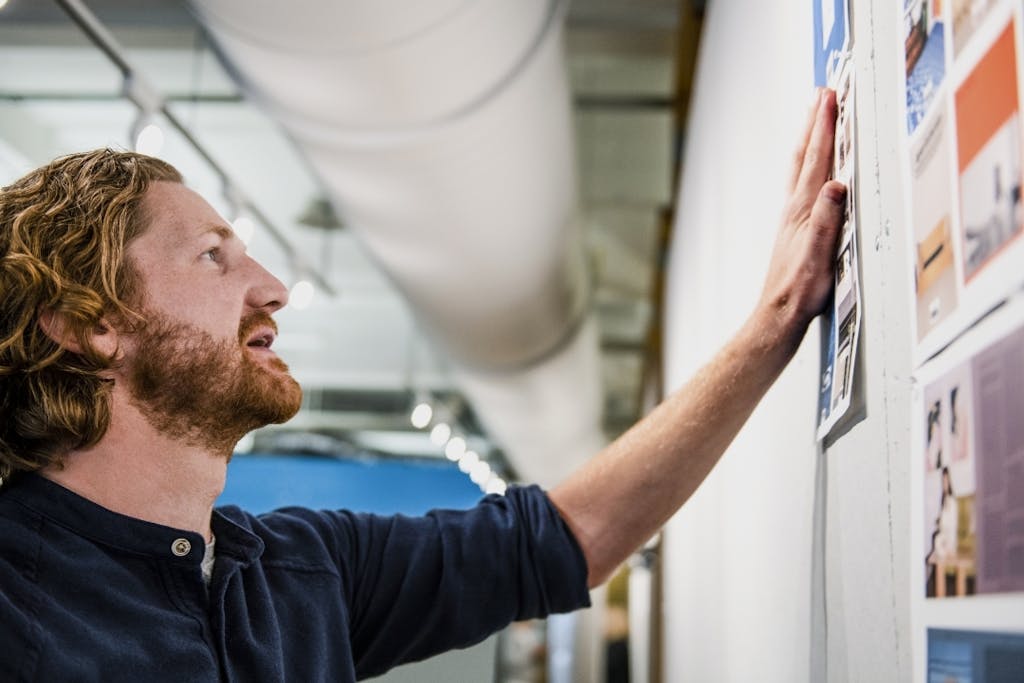
Our user experience strategies led to design concepting. We generated multiple concepts and put them up on the wall for review. One prevailed. The one you’re experiencing now. As we brought people through a prototyped version of the Web site, they reacted positively to the design and photography style. We hope your reaction is the same, but we also want to make sure the experience delivers on getting you to the information you’re seeking easily and efficiently.
Usability
During our usability sessions, we also observed people hesitantly browsing through our progressively created navigation system. A system built on the search-based tagging previously described. We offer five ways for people to navigate: 1) entering a search query, 2) clicking on a trending topic, 3) vertically scrolling through image tiles, 4) horizontally browsing via contextual links and 5) using the keyboard. Usability findings led to design and functionality tweaks that resulted in an experience surpassing the standards our team set. Time to go live.
An Experience Built From Behavior
Going live is only the initiation of what the experience will eventually come to be. The Web site as it exists today serves as the foundational platform we will constantly monitor and change to adapt to visitor behavior. Meaning, the next time you come back, your experience will be better. Furthermore, we continue to add content to the site (e.g., case studies, blog posts). Another reason to come back. In the meantime, I encourage you to leave a comment below or offer feedback through the survey we’ve created.
FEED IT Recap: Scott Belsky
“Ideas don’t happen because they’re great or by accident.”
This was Scott Belsky’s answer when I asked what one thing he hoped people would take away from reading his national best-selling book, Making Ideas Happen.
It was an interesting answer, but it prompts an obvious next question, “How then do we make ideas happen?”
While Scott visited Colle+McVoy on July 15, 2011, I sat down with him for an exclusive interview in the hopes of gathering his insights on how we, as marketers, can increase the possibility of our ideas being shared with the world. In short, how we can make ideas happen.
What follows is a brief synopsis of the interview, outlining the five main themes that stood out.
Find Your Work Sweet Spot
Scott has always been passionate about facilitating creative production, which served as the impetus for his transition from working in leadership development at Goldman Sachs to starting Behance, an organization focused on matching the best creative talent with the best creative opportunity. “I needed to do something in a world I’m passionate about and with people I love working with.” But passion alone did not make him successful. He was able to align his enthusiasm for organizing creativity with his unique skills and opportunity streams.
Scott found his work sweet spot, have you?
Be a Student of Your Craft
During our conversation, Scott referred to himself as “a student studying design firms, agencies and creative leaders across industries to understand what they are struggling with.” As a student of organizing the creative world, Scott has identified creative professionals defying the odds and who offer a world of knowledge he can learn from. Whatever your creative craft, obsess over how you can find ways to learn more. Given the accessibility the Internet allows all of us today, this has become easier than ever.
Creativity Is a Responsibility
The name Behance came from the word “enhance,” which means to make something better, and “be,” which means being authentic and never compromising. The mission of Behance is to empower creative professionals to make ideas happen. A focus on pushing ideas to completion initiates a sense of responsibility and accountability among creative professionals. In Scott’s words, “Every artist and every creative mind should not only see their creativity as an opportunity, but also a responsibility.”
Embrace Distributed Creative Production
Advertising agencies focus on gathering all the best creative minds in-house. Scott argues this model is not sustainable because the best creative minds are going to be free radicals. “They’re going to be working on their own terms, wherever they are in the world. And they’re going to have greater output as a result of that autonomy,” Scott explained. He refers to this philosophy as “distributed creative production” and believes agencies need to embrace this idea to flourish.
Focus on Process and Kill Ideas
Ideas are plentiful in the agency world. We invest an incredible amount of time and energy in coming up with insights and ideas that allow a brand to stand out. Scott believes we should dedicate the same amount of resources to discussing how our process is organized. Rather than subscribing to the status quo, he encourages organizations to question process and test different methodologies to influence change. And during the daily execution of an idea, the tendency should be to kill ideas. “When ideas come up, the immune system of a productive creative team needs to quickly quench them in order to keep on track. We should only allow new ideas to take us off track during brainstorms,” Scott pleaded as we wrapped up our interview.
I’ll end this overview with Scott’s favorite quote from Thomas Edison: “Genius is one percent inspiration and ninety-nine percent perspiration.” Executional excellence is vital to making ideas happen. This is also the inspiration behind Scott naming Behance’s think tank The 99 Percent.
So which side are you on, the one percent or the ninety-nine percent? I welcome your thoughts below.
Scott Belsky, Making Ideas Happen
Colle+McVoy FeedIt Scott Belsky


-
26964453
-
http://www.collemcvoy.com/wp-content/themes/images/ss_image/cmcv_feedit_scottbelsky_910_1.jpg
-
http://www.collemcvoy.com/wp-content/themes/images/ss_image/cmcv_feedit_scottbelsky_910_2.jpg
-
http://www.collemcvoy.com/wp-content/themes/images/ss_image/cmcv_feedit_scottbelsky_910_3.jpg
-
http://www.collemcvoy.com/wp-content/themes/images/ss_image/cmcv_feedit_scottbelsky_910_4.jpg
-
http://www.collemcvoy.com/wp-content/themes/images/ss_image/cmcv_feedit_scottbelsky_910_5.jpg
-
http://www.collemcvoy.com/wp-content/themes/images/ss_image/cmcv_feedit_scottbelsky_910_6.jpg
About Scott
According to Fast Company, Scott is one of the "100 Most Creative People in Business." He's accomplished this by founding Behance, the world's leading online platform for creative professionals. Over the years, Behance has developed a series of products to help organize and empower the careers of creative professionals. Scott is also the author of the national bestselling book Making Ideas Happen.
Making Ideas Happen
Scott Belsky presented as part of Colle+McVoy's FEED IT inspirational series on July 15, 2011. While he was here, Scott discussed common practices shared by the most productive creative teams worldwide. We sat down with Scott for an exclusive interview in the hopes of gathering his insights on how we, as marketers, can increase the possibility of our ideas being shared with the world. In short, how we can make ideas happen.
About Summer Hours on the Solstice
Whether we see them as an early start to the weekend or as a jumping-off point for well-earned, longer-term vacation, we love our summer hours at Colle+McVoy!
This year, the program is back again by popular demand, even being mentioned by the Star Tribune in their selection of Colle+McVoy as one of the Top 100 Workplaces in Minnesota.
With summer in mind during last week’s rooftop carnival-cum-quarterly-meeting, our CFO urged us to take advantage of the extra time to get out of the office and explore a little bit more of the state we all call home. Disclosure: As a member of the Explore Minnesota team, I will unabashedly take any and all opportunities to proselytize about how diverse (and great!) the options are for vacations right here in Minnesota! I absolutely LOVE that there are more of us at the office who feel the same way!
I also love working for a creative advertising agency whose leadership implores us to get out of the office and use our vacation time. Only 38 percent of Americans actually take all their vacation days, according to this article in CNNMoney. That figure could surely be increased with a leadership group as supportive as ours.
In any event, my coworkers will all be asking themselves similar questions as Friday afternoons approach:
Are our loose ends tied up for the week?
Have we called our clients and wished them well for the weekend?
Did we do our timesheets?
If so, we’re free to depart for distant shores. The caveat again being that I really, truly hope those shores are located in-state. An early start to backyard tasks and household chores is also fair game.
So what do Colle+McVoyers actually plan to do with their summer hours? We took an internal poll recently to find some answers. Our own Sean Cooley helped make sense of the numbers.
Here’s to the #solstice. Happy summer!
About Us
We are the enemies of the ordinary.
The adversaries of the usual.
The opposite of average.
Why? Because we believe complex business challenges can be transformed into rewarding opportunities through standout work. We’ve assembled a team of 200 passionate individuals who take great pride in building big ideas that lead to better results.
Our Work
Just because you bought an impression doesn’t mean you’ve made one.
As an agency, as teams, as individuals, every day we challenge ourselves to make our capabilities even more capable. We do this by making sure everything we do is built on consumer insights and a strong strategic foundation. From account planning to media planning and buying to public relations and social media to advertising, design, and digital, we relentlessly pursue ways to uniquely position brands for success. The outcome is a culture that is fueled by doing what is right rather than by doing what is easy.
Take Me Fishing: Building The Nation’s Number One Online Resource
TakeMeFishing.org Case Study


-
25824969
-
http://www.collemcvoy.com/wp-content/themes/images/ss_image/rbff_takemefishing_910_2.jpg
-
http://www.collemcvoy.com/wp-content/themes/images/ss_image/rbff_takemefishing_910_3.jpg
-
http://www.collemcvoy.com/wp-content/themes/images/ss_image/rbff_takemefishing_910_4.jpg
-
http://www.collemcvoy.com/wp-content/themes/images/ss_image/rbff_mobile_910_1.jpg
-
http://www.collemcvoy.com/wp-content/themes/images/ss_image/rbff_print_910_3.jpg
-
23997708
-
http://www.collemcvoy.com/wp-content/themes/images/ss_image/rbff_nontradprint_910_1.jpg
-
http://www.collemcvoy.com/wp-content/themes/images/ss_image/rbff_catchaboat_910_1.jpg
-
http://www.collemcvoy.com/wp-content/themes/images/ss_image/rbff_catchaboat_910_2.jpg
-
http://www.collemcvoy.com/wp-content/themes/images/ss_image/rbff_mastercasters_910_1.jpg
-
4906304
Visit the site: www.takemefishing.org »
Solution
Fishing and boating have always been ways to escape from everyday stress while connecting with friends, family and nature. Research indicated that we needed to make the sport of fishing relevant to today’s consumer who was not motivated by nostalgia or serenity, but rather by active experiences and socialization. That led us to our core insight: Where land ends, life begins. That insight has helped us make TakeMeFishing.org the nation’s primary vehicle for increasing interest and participation in boating and fishing. Along the way, site traffic has quadrupled in under four years. The fully integrated, award-winning Take Me Fishing™ campaign contributed to an increase in overall license sales in 2009, marking the highest increase in fishing license sales since the 1970s. An increase in participation has also helped generate millions of additional dollars for conservation efforts.
Challenge
The Recreational Boating & Fishing Foundation (RBFF), the nonprofit organization behind TakeMeFishing.org, is dedicated to aquatic conservation and increasing participation in fishing and boating. When we began working with RBFF in 2008, fishing license sales and participation had been on a steady decline. Since license proceeds go back to protecting the nation’s aquatic resources, Colle+McVoy was given the assignment of increasing participation and preserving a classic American pastime for future generations.
C+M Recognized at Best of NAMA National Awards Competition
MINNEAPOLIS, April 22, 2010 - Colle+McVoy received several awards from The National Agri-Marketing Association (NAMA) during last night’s national 2010 Best of NAMA awards ceremony in Kansas City. The Best of NAMA program recognizes excellence in advertising, public relations and digital communications in agribusiness and related industries.
"Colle+McVoy is dedicated to creating powerful communications that lead the agricultural industry," said Christine Fruechte, Colle+McVoy president and CEO. "We are grateful and honored to receive this recognition of our teams’ impactful strategic thinking and fresh creativity."
Colle+McVoy received a first place award for its Answer Plot® campaign created for Winfield Solutions, LLC. The multimedia campaign strategically encouraged growers to attend Answer Plot® Program experiences that showcased the technological benefits of Winfield Solutions, LLC products.
Colle+McVoy also earned a first place award for the This Could Be the Year campaign created for Nestlé Purina PetCare Company’s line of Purina® Pro Plan® dry dog food. The campaign advertisements, targeted to dog breeders and enthusiasts, used beautiful photography and bold headlines to emphasize the influence of high-quality nutrition on a dog’s performance.
Colle+McVoy also received a merit award for company magazine work on behalf of CHS Inc. These national awards are in addition to eleven regional NAMA awards won by Colle+McVoy and Exponent PR, the public relations division of Colle+McVoy.
Doritos Had Most Talked About Super Bowl Ad, According To Twitter
Squawq provides immediate feedback from Twittersphere on America’s discussions about ads, brands and teams
MINNEAPOLIS, February 5, 2010 - The Doritos House Rules commercial was the most talked about television advertisement on Twitter during the 2010 Super Bowl, according to Squawq, a Web tool created by ad agency Colle+McVoy that tracks and analyzes conversations on Twitter. The Doritos brand as a whole received more than 35,000 tweets during the game for its ads, but most of these (more than 21,000 tweets) were received immediately after the House Rules spot aired, indicating its popularity. "We’re not sure if the House Rules spot will ultimately win the big prize money in the Doritos Crash The Super Bowl promotion, but they won on Twitter tonight," said Mike Caguin, executive creative director of Colle+McVoy. By monitoring and analyzing the volume of chatter on Twitter about advertisements, brands and Super Bowl topics, Squawq provided an immediate snapshot of people’s opinions on game day. It ranked the most talked about brands, advertisements and teams during and right after the game. Results can be found at http://squawq.com/superbowl/. "We created Squawq last year for our clients to track conversations about their brands and businesses on Twitter," said Caguin. "Squawq has been extremely useful, fun and easy to use, so we wanted to see what it would reveal during a major television event like the Super Bowl. Never before have we been able to gauge public interest and opinions so quickly."
According to Squawq, the top ten advertisers that spurred the most Twitter chatter as of 10 pm EST were Frito-Lay (Doritos), Anheuser-Busch (Bud, Bud Light, Select 55), Coca-Cola, Unilever (Dove), Audi of America, Focus on the Family, Mars (Snickers), Google, Levi Straus & Co. (Dockers), and E*Trade. Squawq uncovered other interesting results from its Twitter analysis during the Super bowl, including:
- The Saints won on Twitter too, generating 90 percent more tweets than the Colts, with over 675,000 tweets by game end.
- In a cost per tweet comparison (based on an estimated cost for a 30 second Super Bowl spot vs. number of tweets), Frito Lay (Doritos), Unilever (Dove), Audi of America, Focus on the Family and Google came out on top.
- Twitter chatter about the brands and ads was at its peak in the first quarter and then waned as the game went on, reflecting the anticipation of the game.
How Squawq Works - Squawq (found at squawq.com) is one of the most well-designed and user-friendly Twitter analytics Web tools. For the duration of the Super Bowl, Squawq tracked and analyzed tweet volume, popular keywords, hashtags, and URLs associated with the Super Bowl. For each brand, a search query was constructed that tracked keywords specific to that brand. For instance, for Coca-Cola, all tweets that either contain the word "Coke," or both the words "Coca" and "Cola" were tracked, as well as key words related to its advertisements. As tweets came in, Squawq compared them against each brand’s search terms and updated the results in the official Super Bowl graph found at www.Squawq.com/superbowl. Track the chatter Squawq Super Bowl.
C+M Named Digital Agency For Land O’Lakes Dairy Foods
MINNEAPOLIS, Jan. 7, 2010 - Today Colle+McVoy was named digital agency for Land O’Lakes Dairy Foods Division of Land O’Lakes, Inc. The agency will manage the consumer Web site, including strategy, creative, production and development.
"We are very impressed with Colle+McVoy’s interactive expertise and technical capabilities," said Thea Keamy, Vice President, Retail Cheese & Marketing Services, Land O’Lakes. "It was imperative that the team we selected resonated with our team, which was apparent with Colle+McVoy throughout the selection process."
Colle+McVoy will build and maintain landolakes.com, including the LAND O LAKES® Simple Rewards® Club, oversee search initiatives, and provide comprehensive Web analytics support.
"We are thrilled to expand our relationship with Land O’Lakes to the consumer foods business," said Christine Fruechte, president and CEO, Colle+McVoy. "We value our ongoing partnership and look forward to helping build deeper relationships with consumers online."
Becoming digital agency for the Dairy Foods business of Land O’Lakes is the next chapter in the agency’s transformative growth story. Colle+McVoy’s interactive billings have doubled since 2007 and now account for more than 40 percent of the agency’s revenue. The agency overall has experienced remarkable year-over-year growth in recent years and expects this momentum to continue in 2010.
C+M Wins Caribou Coffee Account
Named agency of record for second-largest coffeehouse operator in America
MINNEAPOLIS, February 20, 2009 - Colle+McVoy received a strong shot of new business after being named agency of record for Caribou Coffee, the second-largest company-owned gourmet coffeehouse operator in the United States. The agency was selected after a very competitive and challenging search.
"Colle+McVoy’s approach was very courageous. Their creative ideas pushed our brand in a more innovative direction, which we believe will help differentiate it for today’s customers and future generations," said Caribou Coffee Senior Vice President of Marketing Alfredo Martel. "The team presented a comprehensive strategy to drive growth and create long-term value, as well as actionable solutions for our immediate needs."
"We have been given an amazing opportunity to help Caribou Coffee become the leading gourmet coffee brand in the world," said Christine Fruechte, president and CEO, Colle+McVoy. "Every idea we create needs to be engaging and tell the brand’s memorable story through groundbreaking programs." Colle+McVoy ended 2008 with revenues at an eight-year high, driven, in part, by high-profile assignments from ESPN, Yahoo! Messenger, Recreational Boating & Fishing Foundation, and Manhattan Toy Company, to name a few.
Colle+McVoy will share in the brand strategy and planning, as well as manage the day-to-day execution of all marketing campaigns for Caribou Coffee, including brand identity, package design, interactive, advertising and promotions. The scope includes consumer marketing via all channels (trade, retail and online). Program budgets have not been finalized.